AVZ Law Office | Private Client Lawyers in Cyprus

Property Division in Cyprus: 7 Legal Routes for Co-Owners
Grigoris Aivazidis
Lawyer and International Tax Adviser
Cyprus Bar Association Registration No. 7940
Original publication: 13 June 2023
Last substantive legal review: 19 July 2026
Jurisdiction: Republic of Cyprus
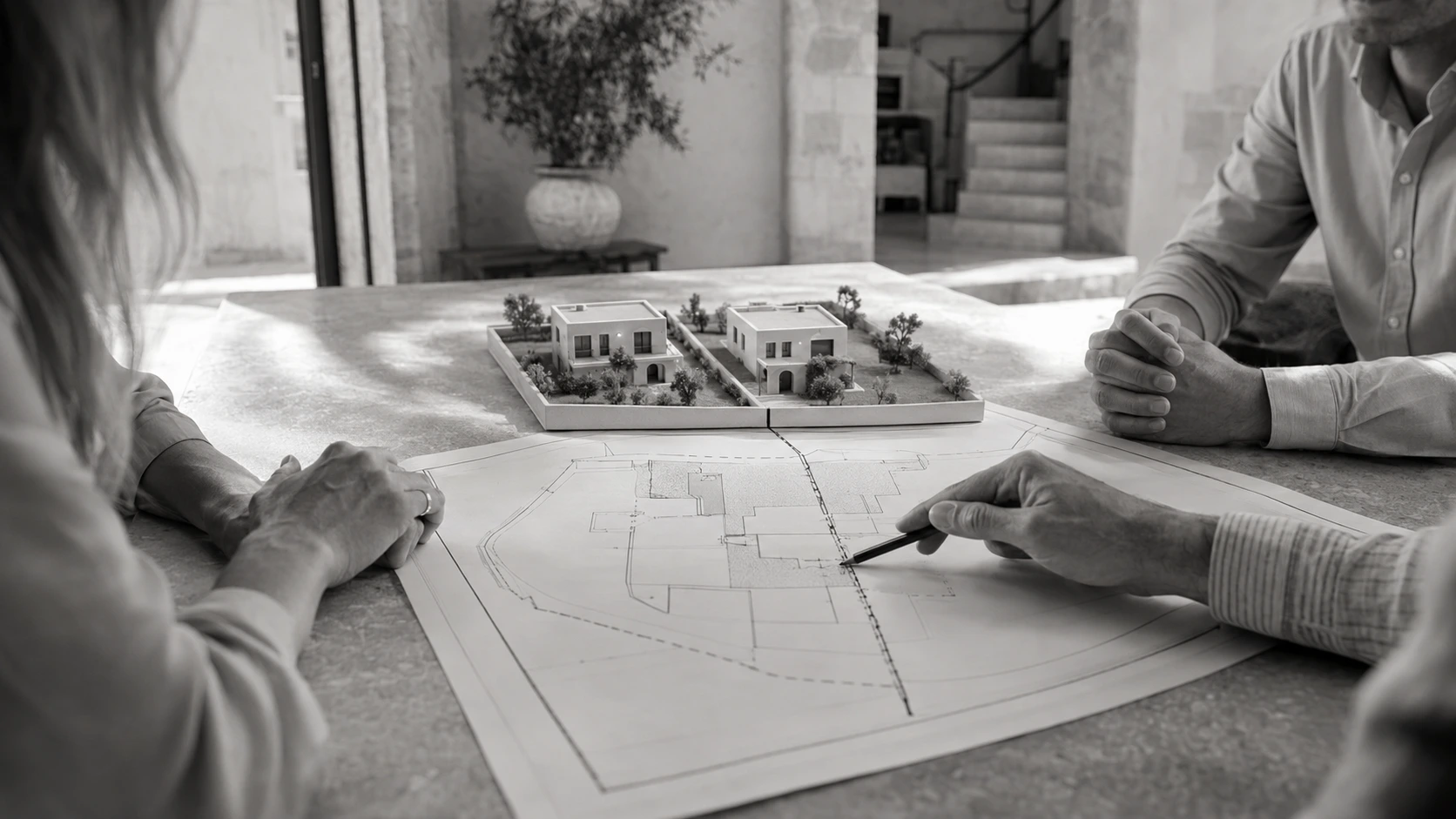
Property division in Cyprus is not simply the drawing of a line across a plan. The intended division must be legally possible, technically workable and capable of registration by the Department of Lands and Surveys.
Co-ownership frequently arises through inheritance, family transfers, joint development or the purchase of undivided shares. Each co-owner holds an ideal share in the whole registered property unless separate ownership has already been created. Exclusive occupation of a house, floor, garden or parking area does not by itself create a separate title deed.
The available routes range from a negotiated transfer or distribution agreement to agreed division, compulsory division, vertical or horizontal division, forced updating of the registration and, where division is impossible, a statutory sale process. The correct route should be identified before money is spent on plans, permits or construction.
Property Division at a Glance
Start With the Registered Position
Test Planning and Physical Feasibility
Choose the Correct Legal Route
Create Registration, Not Informal Use
What Property Division in Cyprus Actually Means
When land is registered in undivided ideal shares, a co-owner does not normally own a specific physical corner merely because their title states one half or one third. The share extends across the registered property. A family arrangement allowing one sibling to use the house and another to use the field can be valuable evidence, but it does not automatically replace the Land Register.
A legal division changes that position. It can create new parcels, separate units or another registered allocation recognised by the Department of Lands and Surveys. Depending on the property, the process can require a preliminary survey plan, planning permission, a subdivision or building permit, approval certificates, licensed survey work, allocation of access and services, and settlement of charges or compensation.
Division must also be distinguished from the sale of an undivided share, a transfer between co-owners, a distribution agreement and horizontal registration of units in a jointly-owned building. Each route has different legal effects, costs and risks.
The Feasibility Review Before Any Application
The first review should obtain a recent title deed and Land Registry search. The lawyer and technical advisers should identify the registered owners, percentages, extent, boundaries, access, easements, mortgages, memos, prohibitions, deposited sale contracts and whether the buildings appear on the registration.
The planning and building position comes next. Fixed assumptions such as every plot being 500 square metres or every residential property carrying a 90% building coefficient are unsafe. Permitted area, frontage, access, building density, coverage, height, public-space conditions and minimum parcel requirements depend on the applicable zone, development plan, permits and site.
Existing structures must be compared with approved plans. Unauthorised additions, changed uses, missing approvals or buildings crossing a proposed boundary can prevent or complicate separate registration. The possible route should be confirmed with the appropriate architect, engineer or licensed surveyor before final legal documents are signed.
Exclusive use is not the same as separate ownership. A house, floor, garden or parking space becomes independently transferable only when the legal and registration framework supports that right.
Seven Legal Routes for Co-Owners
1. Negotiated Transfer or Buyout
The simplest solution can be a transfer of one co-owner’s share to another for an agreed price or through a family arrangement. The parties should verify value, financing, taxes, charges, succession implications and whether consents or releases are needed.
A buyout ends co-ownership without creating new parcels. It is often more economical when the property cannot be physically divided or one person already occupies and maintains it. Written terms should address payment, possession, existing income, expenses and completion at the Land Registry.
2. Agreed Division and Distribution
Where every co-owner agrees and the property can lawfully be divided, the parties can approve a plan allocating the resulting parcels or units. The allocation should reflect registered shares or provide for an agreed balancing payment where values differ.
Agreement does not dispense with planning, building or Land Registry requirements. The parties need a coordinated legal and technical file, including plans, permits, consents, access, services, title information and the documents required for registration.
3. Compulsory Division Under Section 29
Section 29 of the Immovable Property Law, Cap. 224 allows the Director of Lands and Surveys, on the application of a co-owner, to arrange division of property held in undivided shares and register the resulting parcels to the persons receiving them.
The Director seeks, as far as possible, to distribute according to the co-owners’ wishes. Where equal value cannot be allocated, compensation can be ordered. Special rules apply to a building used as a co-owner’s permanent residence and to properties that cannot be divided consistently with section 27.
4. Vertical Division Under Section 29(8)
Section 29(8) provides a specific route for vertical division of a plot originating from a land division under the Streets and Buildings framework, together with a building on that plot when the statutory conditions are satisfied.
Each resulting part must be capable of suitable and convenient separate possession and enjoyment. Where a building is involved, the applying co-owner must produce the relevant approval certificate for the part occupied and enjoyed. The statutory restriction concerning prior use of this route must also be checked, including its inheritance and family-transfer exceptions.
5. Horizontal Division and Separate Units
Horizontal division creates separately registered units such as apartments, floors, offices or shops while the land and common areas remain shared according to the registered framework. Each unit receives its own title with its corresponding share in the jointly-owned property and any limited common property allocated for exclusive use.
The process should address common areas, access, parking, storage, exclusive-use rights, management, insurance and unexhausted development rights. A physical wall or separate entrance alone does not create a separate unit title.
6. Forced Updating of the Registration
Where an owner fails to update a registration, section 65ΚΓ of Cap. 224 allows the Director to compel updating on the Director’s initiative or following an application by a competent authority or an interested person. The process can include division and distribution where sufficient evidence makes the arrangement clear and the competent authority has approved the division.
Evidence can include deposited sale and distribution agreements, approved planning or building applications, a specific-performance order or another court decision identifying the relevant part. This route is technical and evidence-driven. It should not be presented as an automatic unilateral division merely because one owner requests it.
7. Compulsory Sale When Division Is Impossible
Some property cannot be divided into at least two lawful and usable parts. Section 28 of Cap. 224 provides a route under which a co-owner can request a certificate that division is impossible because of section 27 and then serve the prescribed notice on the other co-owners.
If the co-owners do not agree within the statutory notice period to allocate the property to one person, the Director has discretion to proceed with a sale by auction and distribute the net proceeds according to the registered interests. The process is not the same as a private sale and should be treated as a last-resort remedy.
Before invoking compulsory sale, the parties should compare a negotiated buyout, open-market sale, family settlement, valuation process or other agreed exit. A forced procedure can reduce control over timing and commercial outcome.
Vertical Division, Horizontal Division and Their Differences
Vertical Division Separates Land-Based Parts
Vertical division is used where the legal framework permits the property to be separated into land-based parts that can be possessed and enjoyed independently. It can be relevant to two houses on one plot or other configurations, but eligibility depends on title history, approvals, access, buildings and the exact conditions of section 29(8).
Horizontal Division Creates Registered Units
Horizontal division is designed for units within a building or complex. The unit is separately owned, while stairs, structure, roof, access routes, installations and other common elements remain jointly owned unless lawfully allocated as limited common property.
The Final Approval and Registration Link
Approval documentation and conformity with the authorised development are central to registration. The required certificate depends on the facts and can include an approval certificate, approval certificate with notes or certificate concerning unauthorised works where the legislation permits.
Distribution Agreements, Development Rights and Common Areas
A distribution agreement records how co-owners intend to possess, use or ultimately receive specified parts of the property. It can address houses, floors, gardens, parking, access, income, expenses, maintenance, future development and cooperation with permit or registration applications.
The agreement can be important evidence and can support a deposited sale contract or updating procedure. It does not by itself create a separate title deed, cure an unlawful development or bind public authorities to approve a proposed division.
Development rights require explicit treatment. In a horizontal division, unused development rights not contractually allocated to future co-owners can remain with the original owner and be registered in the manner permitted by Cap. 224. The documents and approved plans should therefore state who benefits from unused building density and where any exclusive-use right can be exercised.
Common areas also need clear governance. A jointly-owned building should have an appropriate management framework. Registered regulations can govern owners’ rights, contributions, insurance, repairs, use and management, while the statutory standard regulations operate where no bespoke regulations have been registered.
Property Division Legal Support in Cyprus
AVZ Law Office can review the title, registered shares, Land Registry search, deposited contracts, charges, succession documents and the existing arrangement among co-owners. We can advise on negotiated transfer, buyout, division and distribution agreements, compulsory division, vertical or horizontal division, objections and the legal steps required for separate registration.
The legal work can be coordinated with architects, engineers and licensed surveyors for feasibility, preliminary plans, permit history, approved drawings, building compliance, access and cadastral work. Where inherited property is involved, the division should also be coordinated with succession and inheritance planning in Cyprus.
Where co-owners disagree, the first objective is to identify whether a commercially sensible settlement remains possible. If not, the available administrative, Land Registry and court remedies should be assessed with their evidence, timing, cost and enforcement consequences.
No lawyer can promise that a proposed physical division will be approved. The final result depends on the registered property, planning framework, permits, technical feasibility, statutory conditions, objections and decisions of the competent authorities.
Key Takeaways
A Share Is Not a Physical Piece
Agreement Helps but Does Not Replace Registration
The Law Provides Routes When Agreement Fails
Relevant Legislation and Official Sources
This briefing reflects Cyprus legislation and official material available at 19 July 2026. Property division is fact-specific and should be checked against the current title, planning zone, permits, approved plans and Land Registry practice.
Relevant Legal Briefings






Legal Notice
This article provides general information on property division in Cyprus as at 19 July 2026. It is not legal, planning, engineering, surveying, valuation or tax advice. The available procedure depends on the title, shares, property characteristics, permits, development rights, charges, occupation and the position of every affected person.
Property Division in Cyprus FAQ
Practical answers to common questions about undivided shares, compulsory division, vertical and horizontal division, distribution agreements, title deeds and sale when division is impossible.
What does property division in Cyprus mean?
It is the legal and technical process of converting co-owned or developed property into separately registered parcels or units, or otherwise allocating ownership through a recognised legal route. Informal occupation alone does not create separate title.
What is the difference between vertical and horizontal property division?
Vertical division separates land-based parts capable of independent possession and enjoyment under the applicable legal route. Horizontal division creates separately registered units within a building while land and common areas remain jointly owned.
Can one co-owner force the division of property in Cyprus?
Potentially. Section 29 of Cap. 224 allows a co-owner to apply for division of property held in undivided shares. Whether division proceeds depends on the statutory requirements, planning feasibility, the property and the rights of affected co-owners.
Can a co-owner holding 25% apply for division?
Section 29(9) provides that, in the cases to which it applies, one or more registered co-owners holding at least 25% can lodge an application and the Director can advance the division process subject to the required preliminary plan and permits.
What happens if co-owned property cannot be physically divided?
Section 28 can provide a procedure involving a certificate that lawful division is impossible, notice to the other co-owners and, if no agreed allocation is reached, a discretionary sale process with distribution of the net proceeds.
Does a property distribution agreement create a separate title deed?
No. It can regulate possession, use, expenses and intended allocation and can provide important evidence. Separate ownership still requires the necessary approvals, statutory process and registration by the Department of Lands and Surveys.
Is final approval required for property division?
Approval documentation is often central where buildings are involved. The exact requirement depends on the route and facts and can include an approval certificate, an approval certificate with notes or another certificate recognised by the applicable legislation.
Can inherited land be divided among beneficiaries?
Yes, where the estate has been administered and the property can be allocated or divided lawfully. The succession documents, registered shares, planning feasibility, values and any balancing payments should be coordinated before registration.
If one co-owner paid for a building, do they automatically own it?
Not necessarily. Construction expenditure or exclusive occupation does not by itself create a separate registered title. Agreements, permits, ownership records, evidence and the legal relationship between the building and land must be examined.
Who owns unused building density after horizontal division?
The documents and approved framework should address it expressly. Cap. 224 contains rules under which unallocated remaining development rights can belong to the original owner and be registered in the legally permitted manner.
Can a co-owner sell an undivided share without dividing the property?
A registered co-owner can generally deal with their share subject to applicable law, charges, contractual restrictions and procedure. A buyer of the share normally enters the same undivided co-ownership unless separate registration is completed.
How long does property division in Cyprus take?
There is no reliable universal period. Timing depends on searches, co-owner agreement, plans, permits, building compliance, objections, cadastral work, authority processing and whether administrative or court procedures become necessary.
PRIVATE PROPERTY ENQUIRY
Resolve co-ownership before value is lost
A confidential review can identify the registered ownership, practical division options, permits, evidence and settlement route before further construction, sale or family disagreement complicates the property.